

Learn how to break relationship patterns and stop repeating the same cycles of unhealthy dynamics with practical steps and expert insights.
How to Stop Repeating Relationship Patterns
Ever feel like you’re dating the same person over and over—just with a different name?
Maybe you’ve noticed that the same arguments play out, just with different people. It can leave you feeling worn out, almost like you’re replaying the same scene over and over.
These cycles don’t mean you’re broken. They’re your nervous system’s way of reaching for what it knows, even if that “familiar” doesn’t feel healthy anymore. Most of these patterns go back to childhood, when we were first figuring out how to belong and feel safe.
At Existence Online Therapy Clinic, we believe that naming the pattern is powerful. Awareness creates the first opening for something softer, steadier, and new.
Why We Repeat Relationship Patterns
Our brains love what feels familiar. If you grew up with certain dynamics, maybe distance, conflict, or unpredictability, your nervous system learned to treat those as “normal.” That early wiring often shows up later in how you choose partners or react in conflict.
Psychologists call this attachment theory. It explains why some people crave closeness, while others avoid it, and why some feel caught between both. Add in past experiences, old hurts, and self-beliefs like “I’m too much” or “I’ll be left anyway”, and the cycle continues.
Signs You’re Caught in a Cycle
Not sure if this applies to you? Here are some common clues:
✅ You keep dating partners who are emotionally unavailable.
✅ The same arguments play out no matter who you’re with.
✅ You feel “stuck”—like no matter what you try, the ending is always the same.
✅ A part of you knows it’s not working, but it still feels hard to let go.
If any of these sound familiar, it doesn’t mean you’ve failed. It means you’re human and your patterns are asking to be seen./
Steps to Break Relationship Patterns
Below are five practical steps. Each is equipped with exercises, examples, and micro-practices so you can actually try them for yourself.
Step 1: Build Self-Awareness
Self-awareness is noticing what happens inside you before you act. It’s the foundation for change.
What to watch for
✅ Thoughts: the stories you tell, e.g., “I’ll be left.”
✅Feelings: fear, shame, panic.
✅Body signals: tight chest, clammy hands, stomach drop.
Simple practices
✅ Two-minute check-in: stop. Name one feeling. Say, “I notice anger” or “I notice tightness.”
✅ Write one line: each day, write where the feeling showed up and what triggered it. e.g., “When M didn’t text back, my chest tightened and I wanted to call.”
✅ Pattern map: draw a short timeline of your past three relationships. Mark what repeated (abandonment, criticism, silence). Seeing it helps.
Small experiments
✅ Pause before you react. Count to 10. Notice the body. Then choose one calm response.
✅ Use an if/then plan: If I feel abandoned, then I will breathe for two minutes and text one fact (not blame). Example text: “I’m feeling anxious. I’ll check in later.”
Step 2: Understand Your Attachment Style
Attachment gives you a map. It explains your default moves in relationships. Knowing yours makes change less scary.
Quick, simple descriptions
✅ Secure: comfortable with closeness and independence.
✅ Anxious: wants a lot of closeness. Fear of being abandoned.
✅Avoidant: values independence. Pulls away when things get close.
✅ Disorganized: mixes worry and avoidance. Can feel chaotic.
Practical steps by style
✅ If you’re anxious: learn slow-checking habits. Practice saying, “I’m feeling anxious. Can we set a time to talk?” Use short, clear requests instead of chasing. Work on self-soothing (breath, grounding, short walks).
✅ If you’re avoidant: try small steps toward vulnerability. Share one low-stakes feeling once a week. Commit to a short check-in with a partner (10 minutes). Notice what being close actually feels like in the body.
✅ If you’re disorganized: safety first. Create a small routine to feel steady (sleep, movement, grounding). Work with a therapist to build consistent care.
Step 3: Challenge Your Core Beliefs
Old beliefs (I’m not lovable, I must please to be safe) run relationships on autopilot. Changing them shifts your choices.
How to spot a core belief
✅ Listen for absolute statements: “I always mess up” or “No one stays.”
✅ Watch how those beliefs push you into old behaviors.
Exercises to reframe beliefs
✅ Evidence list: write proof for the belief and proof against it. This often softens extremes.
✅ Balanced thought: replace “I don’t deserve love” with “I deserve care and I’m learning how to ask for it.” Say it aloud each morning.
✅Small tests: make a small request (ask for a 30-minute call). Record what happens. Use facts to challenge the old story.
A short CBT-style worksheet (do once a week)
- Situation: who, what, when.
- Automatic thought: the belief.
- Feelings: rate intensity 0–10.
- Evidence for/against.
- New balanced thought.
Step 4: Practise New Boundaries & Choices
Boundaries are how you protect your inner life. They’re the practical engine of change.
What a boundary looks like
✅ A boundary is a limit you set to keep yourself safe and respected.
✅It’s specific and kind. Not a punishment.
How to start
✅Name it: “I need more notice before plans change.”
✅Say it early: bring it up before conflict. Example: “I get anxious with lots of last-minute plans. I do best with 24-hour notice.”
✅ Script it: short, neutral lines work best. Example: “I can’t do dinner tonight. I need time to myself.”
Enforcing boundaries kindly
✅ Follow through calmly. If someone crosses a boundary, respond the first time. Don’t pile up anger.
✅ Use a calm exit: “I need to step away. We can talk later.” Then take space.
Choosing different partners
✅ Make a small checklist of values (kindness, consistency, respect). Use it when dating.
✅ Ask early questions: “How do you handle plans changing?” Listen to actions as well as words.
Micro-practices
✅Practice saying “no” to small requests daily. Notice the body.
✅Share one boundary in a low-stakes relationship first.
Step 5: Work with a Professional
Therapy speeds up and steadies change. It gives a safe place to unpick what’s stuck.
What therapy can do
✅ Spot the little spots you miss alone.
✅ Teach tools (breathing, grounding, CBT skills).
✅ Help your body feel safe, not just your head.
What to expect at Existence Online Therapy Clinic
✅ A calm, online space. Soft voice, steady pacing, and body-based practices.
✅A therapist who listens and asks gentle questions.
✅Homework that feels like practice, not punishment.
✅Learn more about our approach here.
Practical therapy tips
✅Try a few sessions to see if the therapist’s style fits you.
✅ Ask about trauma-informed, somatic approaches if your body reacts strongly.
✅ Bring one pattern you notice in each session. Work on one small behavior to change.
When therapy is hard
✅ It’s normal to feel raw. Healing can stir old pain. That means you’re doing meaningful work.
✅ Keep a grounding tool handy (breathing, a small object to hold, a walk) to use after sessions.
Putting It All Together
Learning to break relationship patterns doesn’t happen in one leap. It’s more like taking small steps on a path you’re still figuring out. Some days you’ll notice a habit right away. Other days, the old cycle might pull you back in before you even realize it. Both are part of the process.
What matters most is slowing down enough to notice what’s happening. That moment of noticing is already a form of change. Maybe you catch yourself reacting faster than you’d like. Maybe you recognize the familiar ache of feeling unseen. Or maybe you try a boundary that feels shaky but is still true. These little moments create space for something different to grow.
Over time, the nervous system learns that new ways of relating can feel safe too. The loop that once felt unbreakable starts to loosen. And with practice, patience, and the right kind of support, relationships can begin to feel steadier and kinder.
FAQs
- Why do I keep attracting the same type of partner?
Your nervous system seeks the familiar. Old hurt acts like a magnet. Awareness and practice change that magnet.
- Can therapy really help break relationship patterns?
Yes. Therapy gives tools, safety, and a place to try new things without judgment.
- How long does it take to change patterns?
There’s no fixed timeline. Small, steady steps create lasting change.
- Do attachment styles ever change?
They can. With practice and safe relationships, people grow toward more secure ways of relating.
- Is it possible to break cycles on my own?
You can start on your own. Deep shifts are easier with steady support.
Moving Forward
Breaking relationship patterns is a small, steady practice. It’s about noticing, choosing, and trying again. Things feel different when your body learns safety, your thoughts soften, and your choices line up with your values.
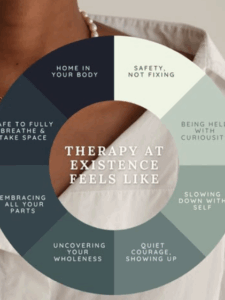
If you want a gentle place to try new ways, Existence Online Therapy Clinic offers trauma-informed, somatic-friendly therapy for adults and couples across Ontario. Imagine a quiet room, your therapist’s calm voice, and a space where your body can finally relax a little. That’s what our online sessions aim to feel like: a soft, steady place to practice being seen.
If you’re ready for gentle support, you can reach out to explore what a first session might look like. No rush. No fixing. Just steady company while you learn new ways to be in relationships.

You don’t have to hold it all together here.
Hi, I’m Laura—a trauma-informed psychotherapist supporting individuals and couples across Ontario. I help those who grew up without emotional safety reconnect with themselves, their bodies, and their relationships.
Many of my clients are the people-pleasers and overthinkers who seem capable on the outside but feel exhausted and “not enough” inside. If that sounds familiar, you don’t have to carry it alone.
Let’s Begin.
If you’re ready to explore what healing could look like – not through fixing, but through feeling, remembering, and reconnecting – I’d be grateful to be part of that process.


Still unsure? We're here to help.
Totally fair to have questions. That’s why we created a full FAQ Centre with real, straightforward answers to things you’re probably already searching—like how online therapy actually works, what your first session might look like, how we match you with a therapist, and how to get started if you’re new to all of this.
Here are a few quick answers to get you going:
A meaningful and supportive therapy journey is ready when you are.
Meet Laura, the founder and therapist at Existence and connect in for free 15-minute intro session. Simple, supportive, and no pressure to commit.
- Professional
- Inclusive
- Curated



Join us @existencetherapy
